What our SGS ASTM F963-23 report on coffee wood covers, and what it doesn't
A lab report is only useful if you know its scope. Ours is a heavy-element test on coffee wood, run by SGS to ASTM F963-23. This guide sets out what was tested, what the result was, what the report does not cover, and how to describe it in a listing without overclaiming.
- For importers and Amazon sellers
- Coffee wood only
- About 6 minutes to read
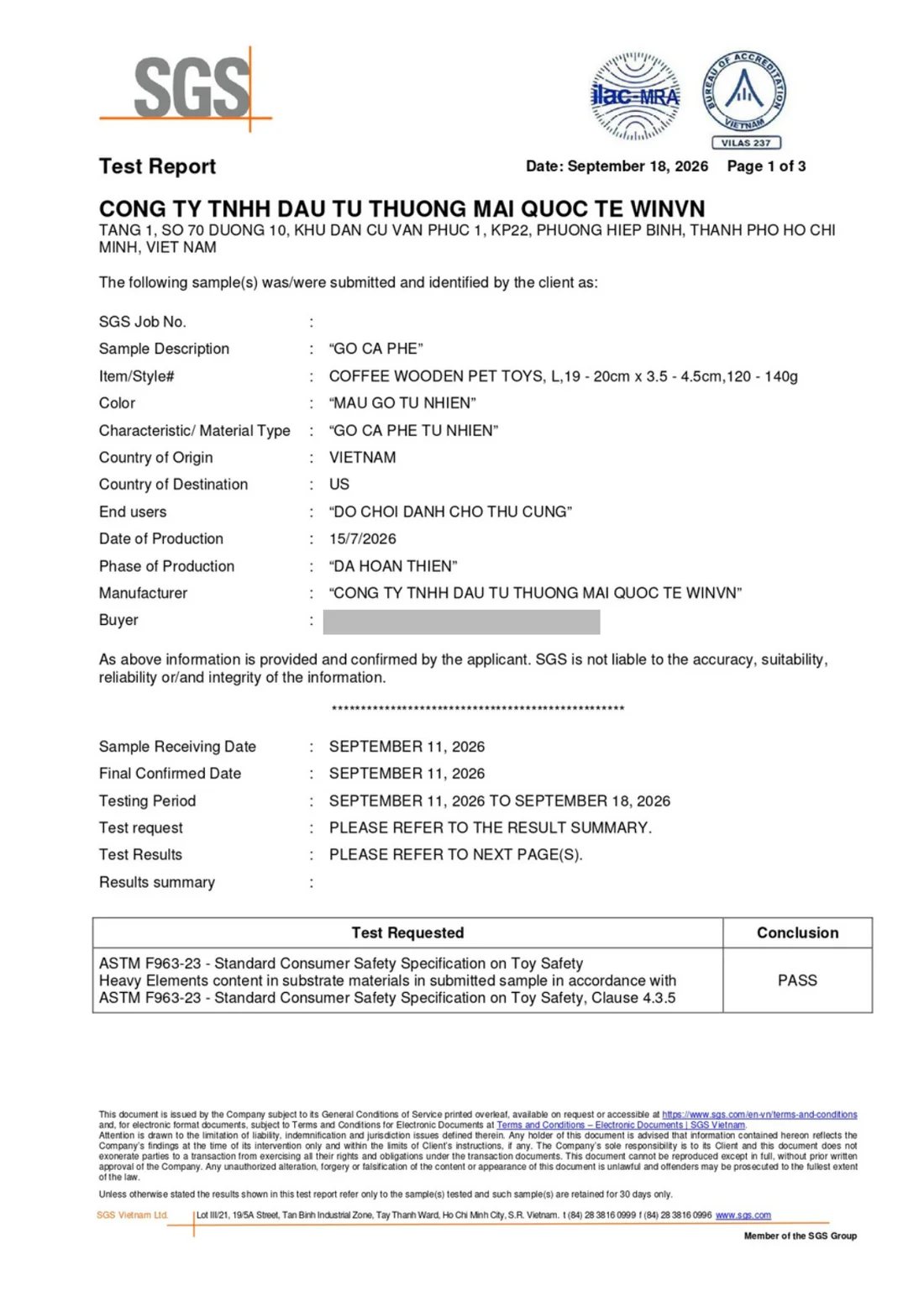
The report at a glance
| Field | What the report says |
|---|---|
| Laboratory | SGS, accredited by VILAS to ISO/IEC 17025:2017 |
| Date | September 2026 |
| Sample | Coffee wood, described on the report as light brown wood |
| Standard | ASTM F963-23, section 4.3.5: heavy elements in substrate materials |
| Method | Soluble heavy elements, measured by ICP-OES |
| Elements | Antimony, arsenic, barium, cadmium, chromium, lead, mercury, selenium |
| Result | PASS. All eight elements not detected |
You can see the masked summary and results pages on our documents page. The report number is hidden there; we send the full report on request, with customer details masked.
What ASTM F963 is, and why it is used for a dog chew
ASTM F963 is the US standard consumer safety specification for toy safety, and F963-23 is its 2023 edition. It is a long document with many separate requirements. Section 4.3.5 is one of them: it limits how much of eight heavy elements can be released from the materials a toy is made of.
ASTM F963 is written for children's toys; it is not a legal requirement for pet products. Buyers use section 4.3.5 as a benchmark. Our report tested coffee wood against that one section. It is not a test of the whole standard.
What the report does not cover
Reading a report's limits is as important as reading its result. Ours does not cover:
- Other product lines. Hemp, coco coir and loofah toys have no lab test yet, and neither do pet beds. We do not show the coffee wood report as proof for anything else.
- Other sections of ASTM F963. The report covers heavy elements in the material, section 4.3.5, and nothing else in the standard.
- Pesticide residues or other chemicals. None were tested.
- Food standards. On our export documents a coffee wood chew is described as a wooden pet toy, because it is a toy, not food.
- Every future shipment. A test report describes the sample that was tested. It is not a certificate for every batch.
- Certifications. We do not hold FSC, BSCI or ISO certification, and we have no REACH test report.
Describing it in your listing
The safest description is the narrowest true one. Words like "certified", "non-toxic" or "100% safe" claim more than a heavy-element test shows, and a marketplace or a customer can ask you to back them up.
Accurate: "Coffee wood tested by SGS for heavy elements to ASTM F963-23, section 4.3.5. Result: pass, all eight elements not detected."
Overclaiming: "SGS certified safe." "Non-toxic, lab approved." "Tested to ASTM F963" with no mention of which section.
If you plan to quote the report, ask us for the original file and use its wording. Do not rely on our summary on this page, or on anyone's retelling of it.
If your market or retailer needs another test
Some buyers need more than this report. How it works with us:
- Tests we already hold are provided to you at no charge. Today that is the SGS coffee wood report.
- New tests are paid by the buyer who needs them. Tell us before ordering, so we can discuss lab, scope and timing.
- Name the substances. A lab can test for thousands of substances. A request for "residue testing" cannot be quoted until it names which substances, against which limit.
- Third-party inspection by a company you choose is paid by the buyer. Tell us the company and the scope.
A useful first question for your own customs broker or compliance adviser: is this test a legal requirement in my market, a retailer's requirement, or a figure found online? The answer decides who needs to pay for what.
How the test fits with the rest of our coffee wood checks
The SGS report answers one question: heavy elements in the wood. Other questions have other answers. Moisture is measured below 14% at the core before vacuum packing; see coffee wood moisture, 14% at the core. Size tolerances are written on the proforma invoice for your order; see coffee wood chew sizes, XS to XXL. The paperwork that travels with the goods is in EU export documents for pet toys.
Our coffee wood comes from mature Robusta trees (20+ years) cleared at the end of their productive life in the Central Highlands, and our coffee wood production is in Đắk Lắk and Gia Lai provinces.
Questions buyers ask about the SGS report
Which products does the SGS report cover?
Coffee wood only. Hemp, coco coir and loofah toys have no lab test yet.
What exactly was tested?
Soluble heavy elements in the wood under ASTM F963-23 section 4.3.5: antimony, arsenic, barium, cadmium, chromium, lead, mercury and selenium. All eight were not detected, and the result is a pass.
Is ASTM F963 required for pet products?
No. ASTM F963 is written for children's toys and is not a legal requirement for pet products. Buyers use section 4.3.5 as a benchmark for heavy elements.
Does the report cover pesticide residues?
No. It covers heavy elements only. If you need a residue test, tell us which substances and limits before ordering; new tests are paid by the buyer who needs them.
Can I write "SGS certified" on my listing?
We advise against it. The report is a test of a sample to one section of ASTM F963-23, not a certification. Describe it by its scope and quote the original report's wording.
Ask for the report with your samples
Tell us your market and how you plan to list the product, and ask for the report in the same message.